
In the commercial plastics sector, there is a persistent elephant in the recycling room that rarely gets discussed in marketing brochures: aesthetic visual reality.
When a high-volume manufacturer considers switching from virgin resin to recycled content, their engineering team naturally focuses on mechanical performance. However, the procurement and branding teams often harbor a unspoken anxiety: What is this material going to look like?
It is a valid concern. In an ideal world, every piece of incoming commercial waste would arrive beautifully colour-coded and pristine. In the industrial reality of post-commercial recycling, feedstocks arrive as a chaotic kaleidoscope of vibrant primary colours, printed films, and mixed-pigment composites.
At Polymer Processors, we don’t run away from the colour challenge. We have turned a perceived aesthetic limitation into a highly engineered technical advantage. Here is the science behind how we transform multi-pigment waste streams into consistent, premium dark greys and blacks optimised for industrial neutrality.
The Dilemma of the Mixed-Pigment Stream
When you mix blue, green, yellow, and red pigments together, the laws of subtractive colour mixing dictate only one inevitable outcome: a muddy, unpredictable brown. For high-end B2B applications—such as electrical conduits, agricultural pipes, or under-bonnet automotive components—an inconsistent, mottled brown resin is completely unacceptable.
Beyond the visual aspect, mixing coloured plastics introduces hidden technical risks:
- The Blind Blending Trap: Different coloured items often signify different original applications. For instance, a bright blue crate and a safety-orange barrier might both look like rigid plastic, but they may feature entirely different polymer bases or molecular weights.
- Thermal Degradation of Masterbatches: Pigments are held within a carrier resin (a masterbatch). When re-processing mixed plastics, these original pigments and their carriers must be thermally stable enough to survive a second extrusion pass without breaking down and causing structural brittleness.
- Surface Defect Manifestation: If the pigments do not disperse perfectly smoothly during compounding, they create micro-agglomerations. On a production line, these imperfections manifest as visual swirls, surface roughness, or structural weak points in the final molded product.
Re-engineering for Industrial Neutrality
To overcome these challenges, our facility at 11 Japaddy Street treats colour management as a strict chemical process rather than a cosmetic cover-up. We run a highly calculated compounding operation that shifts multi-coloured feeds into a uniform, high-performance industrial dark grey or deep black finish.
Our method relies on three sophisticated technical pillars:
- Molecular Fingerprinting First: Before any colour compounding takes place, we ensure that mixing pigments does not mean mixing incompatible polymer types. Our in-house laboratory utilises Fourier Transform Infrared Spectroscopy (FTIR) to scan incoming coloured streams. By analysing how the plastic molecular structures interact with infrared light, we verify the base chemical composition with absolute certainty. This ensures that only pure, separated streams (such as 100% HDPE or 100% PP) proceed to compounding.
- Controlled Masterbatch Formulation: We do not just melt the coloured plastic and accept whatever shade of dark brown emerges from the die. During the molten phase inside our advanced Italian Erma extruders, we introduce a meticulously calculated percentage of premium carbon black masterbatch. Carbon black does not simply paint over the existing colours; its highly absorptive molecular structure completely masks the underlying multi-pigment matrix. This process locks in a rich, deep, and utterly uniform aesthetic.
- High-Disperse Homogenisation: The secret to preventing surface swirls and structural defects lies in the shear design of our extrusion screws. The Erma compounding lines are engineered to deliver intensive mechanical mixing while the plastic is in its syrupy liquid state. This high-disperse homogenisation forces the original pigments and the new carbon black molecules to blend seamlessly at a microscopic level.
Turning an Aesthetic Negative into a Structural Asset
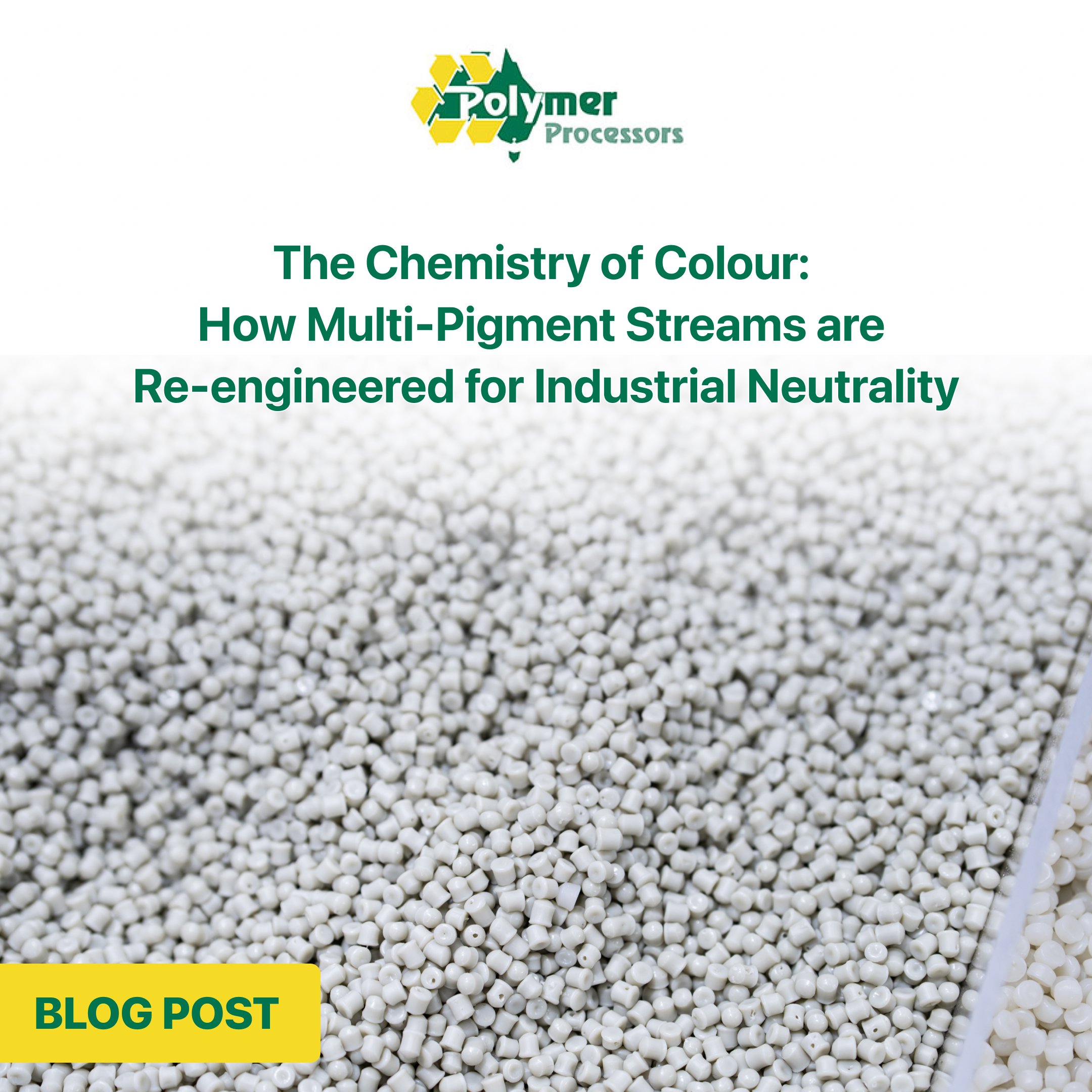
The final product of this precise chemical balancing act is our uniform 3–4mm dark grey or black pellet. Far from being a compromise, this industrial neutrality provides massive functional benefits to product designers and manufacturers:
- Flaw Masking: A uniform dark grey or black resin completely hides any minor structural imperfections, knit lines, or sink marks that naturally occur during high-speed injection molding or profile extrusion.
- UV Protection: The carbon black used to achieve colour neutrality is also one of the world’s most effective natural UV stabilisers. It prevents solar radiation from breaking down the polymer chains, significantly extending the outdoor working life of your final product.
- Batch-to-Batch Predictability: Because we strictly control our compounding formulations, the deep dark shade you buy today will perfectly match the shipment you receive next quarter, protecting your brand’s visual identity.
With our massive 18,000-tonne annual capacity running 24/7, Polymer Processors provides the scale and technical certainty required to confidently transition your product lines away from expensive virgin resins. We prove that a commitment to 100% onshore circularity doesn’t require you to sacrifice the flawless presentation of your industrial products.
Are you ready to see how an engineered, colour-neutral resin can drop directly into your existing tooling?
Contact the team today to request a specification sheet and sample batch of our lab-verified HDPE, PP, or LDPE pellets.