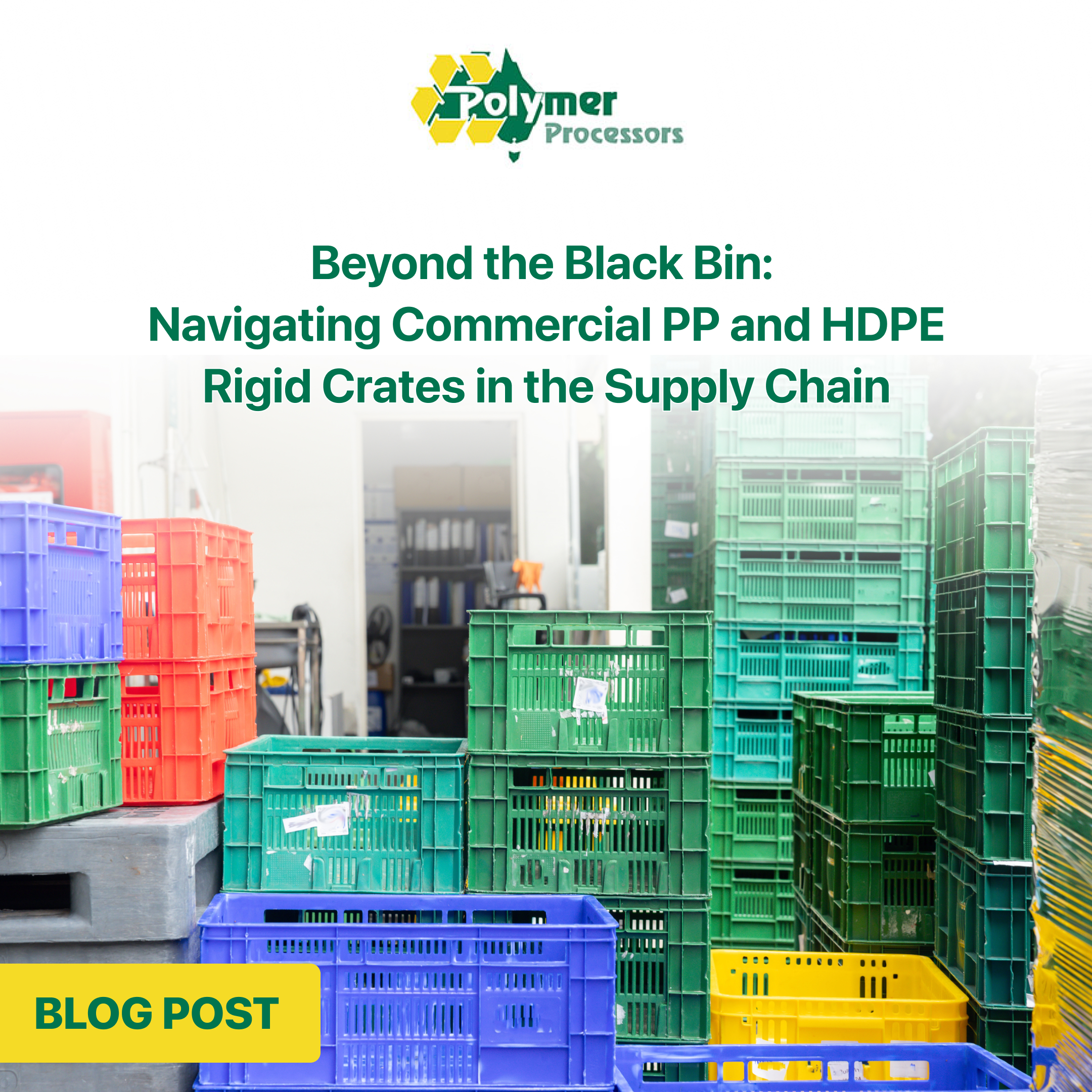
When most businesses review their corporate sustainability targets, their attention naturally drifts towards consumer packaging—the flexible films, retail bottles, and cardboard boxes that fill everyday waste streams. However, hidden in plain sight across Australia’s logistics hubs, distribution centres, and manufacturing floors sits a massive, premium volume of plastic that frequently slips through the cracks: Returnable Transit Packaging (RTP).
From cracked heavy-duty pallets and broken storage totes to split materials-handling crates, rigid Polypropylene (PP) and High-Density Polyethylene (HDPE) assets quietly accumulate in warehouse yards, taking up valuable real estate.
Because these industrial items are highly engineered and heavily modified, they cannot simply be tossed into a standard commercial waste stream. Recycling them effectively requires industrial scale, specialised machinery, and data-driven material science.
The Hidden Value in Your Broken Assets
Unlike single-use packaging, rigid transit crates and pallets are built to endure years of physical punishment. They are manufactured using high-molecular-weight resins designed for maximum impact strength, structural rigidity, and long-term durability.
When these assets finally reach the end of their working life due to structural damage, they represent a highly valuable, clean, and concentrated polymer stream. However, their complex design introduces distinct processing challenges for traditional mechanical recycling:
- Heavy-Duty Additives: To survive years of outdoor exposure and industrial handling, these plastics are packed with UV stabilisers, flame retardants, and reinforcing agents.
- Tough Multi-Resin Profiles: A single logistics yard might house lookalike crates made from completely different base polymers—some injection-moulded PP, others rigid HDPE.
- Physical Bulk: Heavy industrial plastics cannot be processed by standard recycling granulators; they require heavy-duty, high-torque shredding and linear wash systems to handle their sheer mass and structural density.
De-risking the Stream: The Polymer Processors Method
At our Braeside facility, we don’t treat commercial crates as mere scrap; we treat them as highly engineered feedstocks. Managing Director John Wilson Jr. has spearheaded a multi-million dollar technological evolution, equipping our plant to transform these bulky logistics liabilities back into premium-grade manufacturing resins.
To successfully re-engineer these plastics without compromising the final product, our in-house laboratory takes the guesswork out of the equation through two critical analytical steps:
1. Verifying the Polymer DNA
Relying on empirical observation or faded embossed labels on the bottom of a crate is a massive processing risk. A mix-up between HDPE and PP can ruin an entire production batch, as the two polymers do not bond smoothly during extrusion.
Our laboratory utilises advanced Differential Scanning Calorimetry (DSC) to map the unique thermal footprint of incoming crate streams. By measuring how the material absorbs heat, we identify the exact polymer type with absolute certainty, ensuring complete stream separation.
2. Quantifying the Fillers
Many heavy-duty pallets and crates contain inorganic fillers like talc or calcium carbonate to boost stiffness. To understand how these fillers will affect a new manufacturing run, our lab conducts Thermogravimetric Analysis (TGA). By heating the material under controlled conditions and measuring its weight loss profile, we can accurately quantify the exact proportion of non-polymer components. This data allows us to supply our B2B partners with precise Technical Data Sheets (TDS) that mirror the documentation of virgin resins.
Cleaning Up Your Supply Chain for 2027
Operating 24/7 with an annual capacity of 18,000 tonnes, Polymer Processors provides the industrial-scale solution that Australia’s logistics sector requires. Our advanced Italian Sorema wash plants and heavy-duty Erma extruders ensure that labels, grease, and dirt are aggressively stripped away, leaving a pure, uniform 3–4mm pellet ready to go straight back into high-speed injection moulding machinery.
By partnering with a 100% Australian-owned family business, logistics and asset managers can turn their broken transit inventory into a transparent, onshore circular success story—clearing out warehouse yards while hitting strict corporate ESG metrics.
Do you have stockpiles of damaged plastic crates, totes, or pallets cluttering your distribution centres?
Contact the team today to discover how our lab-verified processing can turn your transit waste into a predictable, high-value asset.