

In the plastic manufacturing sector, procurement discussions almost exclusively revolve around chemistry. Procurement managers and engineers spend hours analysing Melt Flow Index (MFI), polymer density, and contamination thresholds. While these chemical properties are undeniably critical, there is an equally vital physical component that directly dictates your factory floor economics: pellet geometry.
When a batch of recycled resin hits your production line, its physical shape and size determine how it behaves inside the feed hopper, the throat, and the initial zones of your extruder barrel.
At Polymer Processors, our in-house laboratory and technical teams don’t just engineer polymer chemistry; we design physical consistency. Here is a look at the mechanical physics behind our standard 3–4mm pellet cut and why it represents the absolute golden ratio for your extruder efficiency.
The Mechanics of the Feed Zone and Bulk Density
To understand why pellet geometry matters, you have to look at the very beginning of the extrusion process: the feed throat. Your extruder screw relies on gravity and consistent volumetric flow to pull pellets from the hopper into the barrel. This process is governed by bulk density—the ratio of the mass of the pellets to the total volume they occupy.
If pellet geometry is inconsistent, your bulk density fluctuates wildly, triggering a chain reaction of processing inefficiencies:
- The Problem with Oversized Pellets: Pellets that are cut too long or thick can easily bridge across the feed throat. This restricts the smooth gravity-fed flow into the screw channels, leading to starve-feeding where the screw isn’t completely filled.
- The Danger of Fines and Fuzz: If a recycler’s pelletiser uses blunt blades, it shears the plastic rather than cleanly cutting it, creating tiny fragments (fines) and stringy tails (fuzz). These small particles melt prematurely in the throat, creating a sticky blockage that stops the material flow entirely.
- The Risk of Irregular Shapes: When a batch contains a chaotic mix of long strands, flat flakes, and chunky blocks, the pellets cannot pack together uniformly. This introduces air pockets into the screw flights, which directly translates to pressure fluctuations at the die head.
Why 3–4mm is the Industrial Sweet Spot
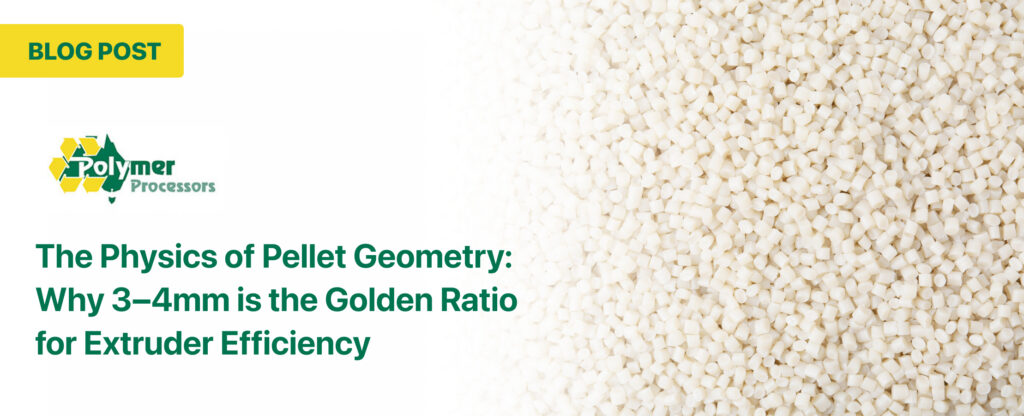
Under the leadership of John Wilson Jr., we have upgraded our Braeside facility with state-of-the-art Italian Erma compounding and extrusion lines. These systems allow us to precisely control the cooling and cutting phase of our recycled HDPE, LDPE, and PP resins, guaranteeing a uniform 3–4mm spherical-cylindrical geometry.
This specific dimension delivers three major operational advantages to your production team:
- Optimised Friction and Internal Shear: Inside the barrel, plastic isn’t just melted by external heater bands; it is melted by the frictional shear generated as the screw compresses and rubs the pellets against each other and the barrel wall. A uniform 3–4mm pellet provides the ideal surface-area-to-mass ratio. It ensures that frictional heat is generated evenly throughout the batch, preventing un-melted pellets from reaching your screen pack.
- Thermal Balance and Energy Savings: If a batch contains an uneven mix of small and large pellets, they will melt at different rates. The smaller pellets will overheat and thermally degrade (shortening the polymer chains and making the final product brittle) while the larger pellets are still solid. A uniform geometric profile means every pellet requires the exact same thermal energy to transition from solid to melt, lowering your overall energy consumption per tonne processed.
- Elimination of Extruder Surging: When the screw receives a perfectly uniform volumetric feed, the head pressure at the die remains rock-solid. This eliminates extruder surging—the rhythmic pulsing of molten plastic exiting the die that causes variations in film thickness or pipe walls. By stabilising your motor load, our pellets protect your expensive thrust bearings and gearboxes from erratic torque spikes.
Backed by Data, Delivered at Scale
Operating 24/7 with an annual capacity of 18,000 tonnes, Polymer Processors is engineered to deliver this level of physical precision on a massive commercial scale. Our lab routinely audits our pelletising lines, ensuring that blade tolerances are razor-sharp and bulk density figures are logged on every single Technical Data Sheet (TDS) we issue.
As a 100% Australian-owned family business, we know that our success is tied to your uptime. We don’t just sell you a sustainable story; we deliver an engineered raw material that keeps your machines running smoothly, predictably, and efficiently.
Are irregular pellet cuts causing pressure spikes or throat blockages on your factory floor?
Contact the team today to enquire about our uniform 3–4mm HDPE, LDPE, or PP pellets, and experience the economic value of precision geometry firsthand.